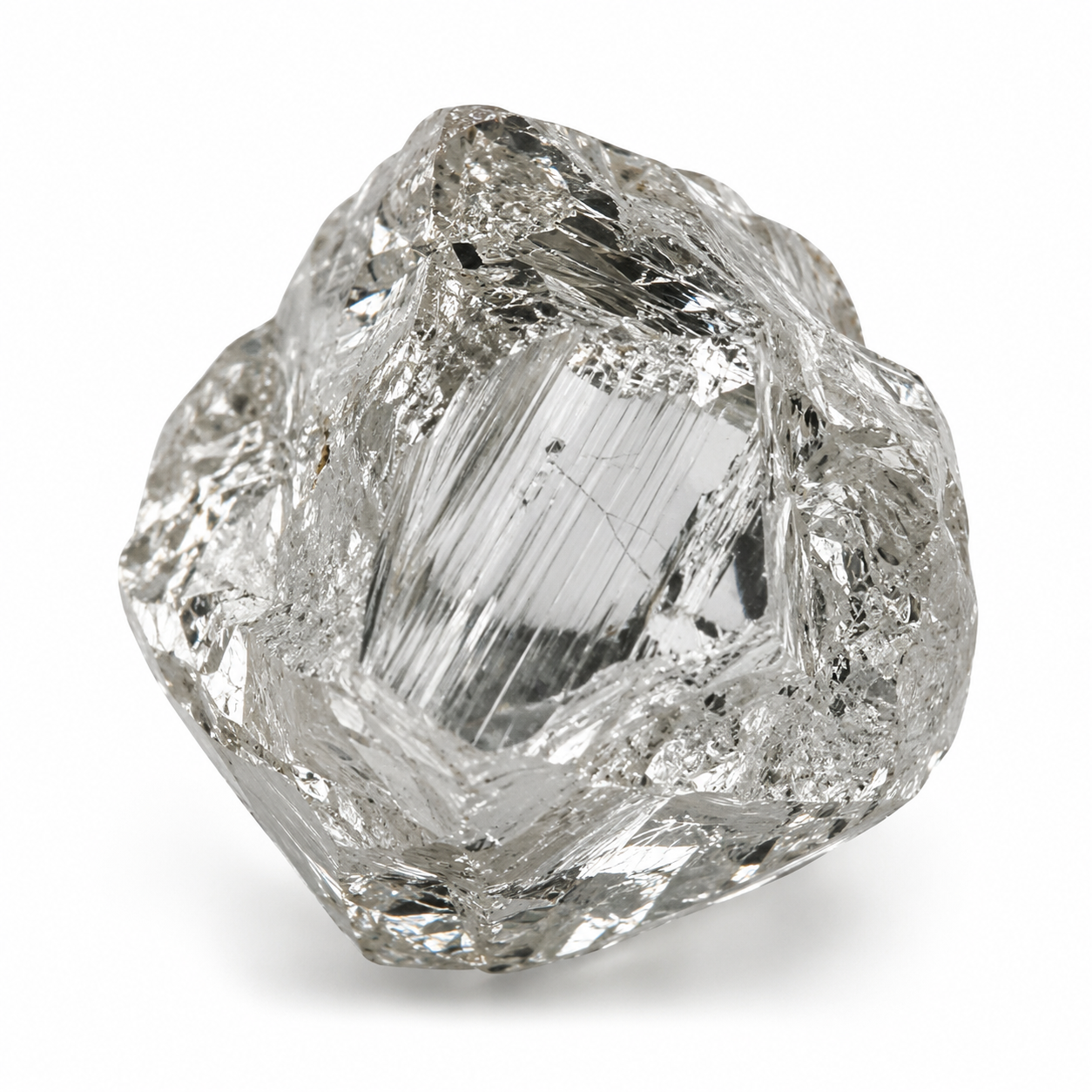
Gemstone profile and identification guide

Diamond

No gemstone has a stronger reputation for durability than diamond, and that reputation is grounded in crystal structure rather than marketing. Its exceptional hardness, high lustre, and ability to return crisp light make it central to both jewellery and industrial applications.

10 Mohs Colourless / Clear, White Native Element
Diamond

Overview

No gemstone has a stronger reputation for durability than diamond, and that reputation is grounded in crystal structure rather than marketing. Its exceptional hardness, high lustre, and ability to return crisp light make it central to both jewellery and industrial applications.

Did you know? Diamond is simply carbon arranged in an unusually strong atomic lattice, which is why the same element can also occur as soft graphite.

Use this profile as a collector reference and educational guide for quick on-page comparison, then validate with the interactive identification system.

Identification

Name: Diamond

Scientific classification: Native Element

Hardness: 10 Mohs

Transparency: transparent

Lustre: adamantine

Crystal system: Isometric (Cubic)

Primary colour: Colourless / Clear

Secondary colour: White

Colour family: Neutrals

Hardness, adamantine brilliance, and sharp facet junctions are key clues. It is commonly compared with moissanite, white sapphire, and glass, so observation of lustre, wear resistance, and optical behaviour matters more than body colour alone.

Verification Status

Status: verified-core-fields

Reference priority: GIA, Gem-A, Mindat, International Gem Society

Core identity fields reviewed against consensus gemological references (GIA/Gem-A/Mindat/IGS).

Some market- and locality-level details may still require citation-grade source notes for publication workflows.

Physical Properties

Hardness category: very hard

Hardness value: 10 Mohs

Chemical composition: Carbon (C)

Crystal system: Isometric (Cubic)

Common locations: Botswana, Russia, Canada, Angola, South Africa, Namibia

Learn more: Gem-A gemstone education resources.

Colour Variations

Diamond sits in the neutrals grouping here, usually reading first as colourless / clear with white appearing as a secondary note or modifier.

Optical effects: Dispersion (fire)

Detailed Gemology

Mineral species: Diamond

Mineral group: Native elements

Chemical formula: Carbon (C)

Mohs hardness: 10

Crystal system: Isometric (Cubic)

Lustre: adamantine

Transparency: transparent

Streak: Colorless

Cleavage: Perfect octahedral cleavage

Fracture: Uneven to conchoidal

Specific gravity: 3.52

Refractive index: 2.417

Optical phenomena: Dispersion (fire)

Colour range: Colourless / Clear, White

Common inclusions: Feathers, crystals, pinpoints, and growth graining

Geological environment: Mantle-derived kimberlite and lamproite pipes with secondary alluvial deposits

Principal mining regions: Botswana, Russia, Canada, Angola, South Africa, Namibia

Important commercial sources: Major modern production includes Botswana, Russia, Canada, Angola, South Africa, and Namibia

Historical significance: Diamond has major historical significance in jewelry, industry, and gemological standards.

Common treatments: Laser drilling, fracture filling, and HPHT/irradiation color treatments occur in trade.

Synthetic or imitation forms: CVD and HPHT synthetic diamonds and simulants such as moissanite and CZ are common.

Common look-alikes: Look-alikes for Diamond depend on color and optical effects in market material.

Jewellery uses: Diamond is used chiefly for Particularly useful where durability matters alongside colour, clarity, or optical performance.. In the trade it is commonly fashioned as faceted stones, calibrated cuts, and higher-clarity collector pieces, with Mohs hardness 10 guiding suitable jewellery applications.

Care recommendations: Handle carefully, avoid impact, and clean with mild soap and water. Store separately to prevent scratches.


Cross-check profile data with GIA Gem Encyclopedia and Mindat entry for Diamond.

Formation

Formed deep within the Earth under extreme pressure and heat, then brought closer to the surface by volcanic eruptions. The final appearance depends on how steadily temperature, pressure, and chemistry remained balanced while the material was growing.

Origin

Major modern production includes Botswana, Russia, Canada, Angola, South Africa, and Namibia

Uses

Best for: Diamond is used chiefly for Particularly useful where durability matters alongside colour, clarity, or optical performance.. In the trade it is commonly fashioned as faceted stones, calibrated cuts, and higher-clarity collector pieces, with Mohs hardness 10 guiding suitable jewellery applications.

Ideal uses: Particularly useful where durability matters alongside colour, clarity, or optical performance.

Diamond FAQ

How can I identify Diamond?

Compare hardness (10 Mohs), crystal system (Isometric (Cubic)), colour profile, and lustre (adamantine) with your sample. Then cross-check related gemstones listed above.

What colour range does Diamond appear in?

Diamond sits in the neutrals grouping here, usually reading first as colourless / clear with white appearing as a secondary note or modifier.

Where is Diamond commonly used?

Particularly useful where durability matters alongside colour, clarity, or optical performance.. For maintenance, follow the care guidance in this profile.