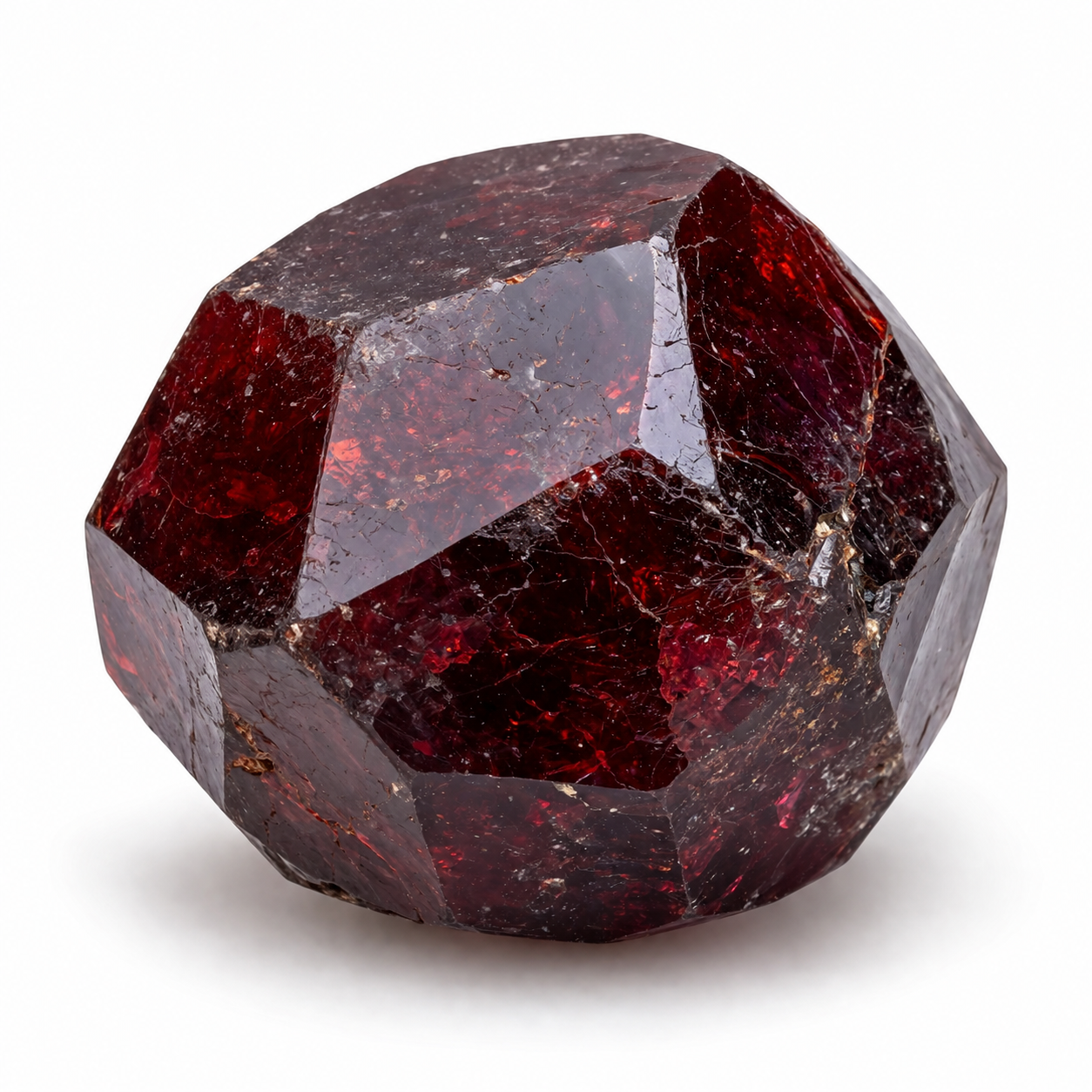
Mineral species: Garnet group
Mineral group: Garnet group
Chemical formula: Nesosilicate group: X3Y2(SiO4)3
Mohs hardness: 7
Crystal system: Isometric (Cubic)
Lustre: vitreous to resinous
Transparency: transparent
Streak: White
Cleavage: None
Fracture: Conchoidal to uneven
Specific gravity: 3.50-4.30 (species-dependent)
Refractive index: 1.73-1.89 (species-dependent)
Optical phenomena: None commonly reported
Colour range: Green, Burgundy, Red
Common inclusions: Crystals, needles, and fingerprint inclusions
Geological environment: Metamorphic and skarn-related environments with alluvial concentrations
Principal mining regions: Mozambique, Tanzania, Madagascar, Sri Lanka, India, Namibia
Important commercial sources: Commercial garnet supply includes East Africa (notably Mozambique and Tanzania), Madagascar, Sri Lanka, and India
Historical significance: Garnets are among the oldest documented gem species in jewelry history.
Common treatments: Most garnets are untreated in trade.
Synthetic or imitation forms: Glass and synthetic alternatives can imitate garnet appearance.
Common look-alikes: tsavorite, demantoid, rhodolite
Jewellery uses: Garnet is used chiefly for Best for jewellery and display pieces where colour, pattern, or internal effect matters more than maximum wear resistance.. In the trade it is commonly fashioned as faceted stones, calibrated cuts, and higher-clarity collector pieces, with Mohs hardness 7 guiding suitable jewellery applications.
Care recommendations: Clean with mild soap and water; avoid harsh chemicals to preserve surface polish.