Gemstone profile and identification guide

Turquoise

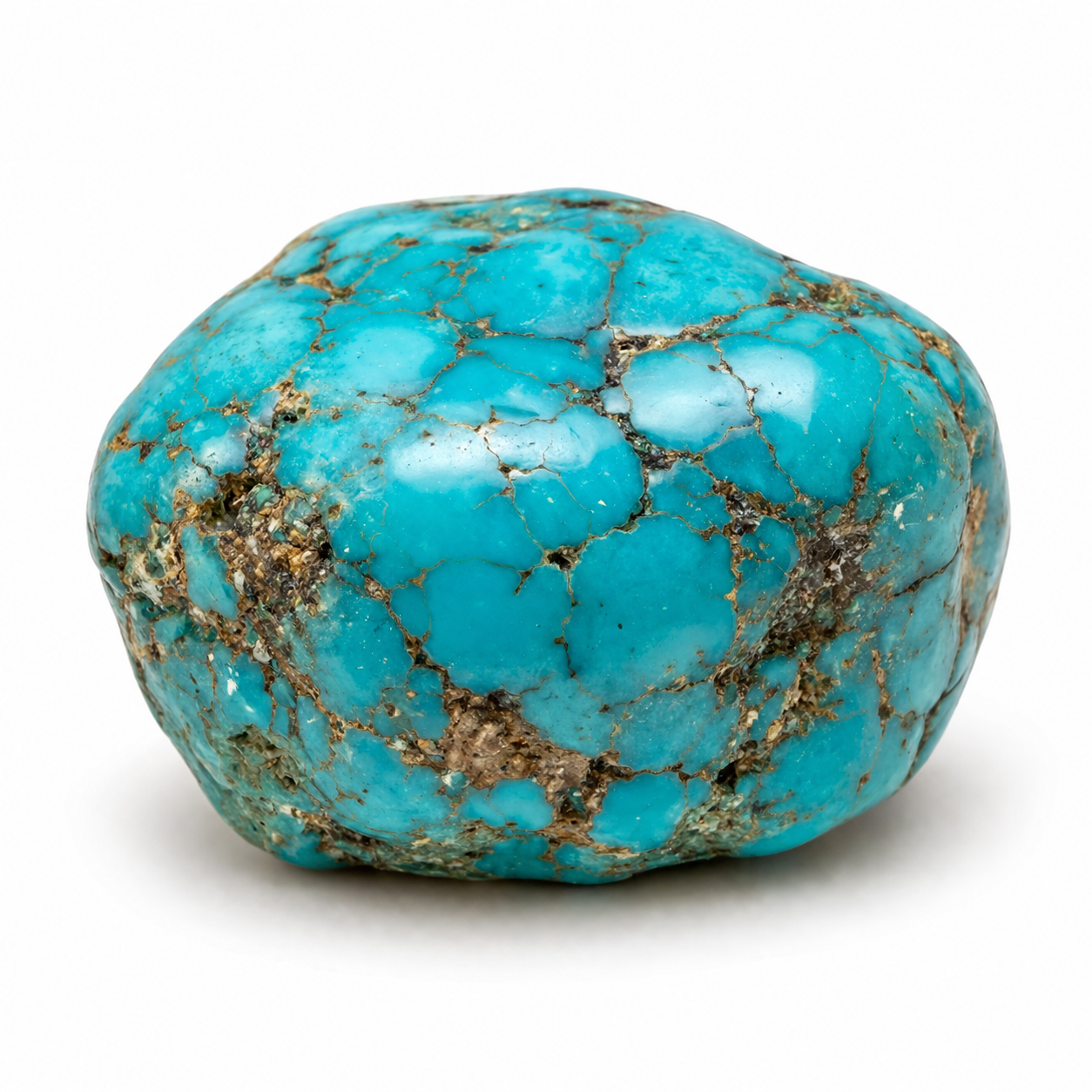
Turquoise has been used for ornament and status objects for millennia, yet its appeal remains straightforward: an unmistakable blue-to-green body colour, often paired with matrix patterns that make each piece visually individual.

5.5 Mohs Blue, Cyan / Blue-Green Phosphate (Turquoise Group)
Turquoise

Overview

Turquoise has been used for ornament and status objects for millennia, yet its appeal remains straightforward: an unmistakable blue-to-green body colour, often paired with matrix patterns that make each piece visually individual.

Did you know? Turquoise colour can shift toward green as iron becomes more influential and toward clearer blue where copper dominates.

Use this profile as a collector reference and educational guide for quick on-page comparison, then validate with the interactive identification system.

Identification

Name: Turquoise

Scientific classification: Phosphate (Turquoise Group)

Hardness: 5.5 Mohs

Transparency: opaque

Lustre: waxy to subvitreous

Crystal system: Triclinic

Primary colour: Blue

Secondary colour: Cyan / Blue-Green

Colour family: Blues & Cyans

Look for opaque blue-green colour, a waxy to subvitreous lustre, and matrix that appears integrated with the stone rather than printed or superficial. It is commonly imitated, so texture and hardness matter.

Verification Status

Status: verified-core-fields

Reference priority: GIA, Gem-A, Mindat, International Gem Society

Core identity fields reviewed against consensus gemological references (GIA/Gem-A/Mindat/IGS).

Some market- and locality-level details may still require citation-grade source notes for publication workflows.

Physical Properties

Hardness category: medium

Hardness value: 5.5 Mohs

Chemical composition: Hydrated copper aluminum phosphate [CuAl6(PO4)4(OH)8.4H2O]

Crystal system: Triclinic

Common locations: Iran (Neyshabur), China (Hubei), United States (Southwest), Egypt (Sinai, historic)

Learn more: Gem-A gemstone education resources.

Colour Variations

Turquoise sits in the blues & cyans grouping here, usually reading first as blue with cyan / blue-green appearing as a secondary note or modifier.

Optical effects: None specified in the current dataset.

Detailed Gemology

Mineral species: Turquoise

Mineral group: Turquoise group

Chemical formula: Hydrated copper aluminum phosphate [CuAl6(PO4)4(OH)8.4H2O]

Mohs hardness: 5.5

Crystal system: Triclinic

Lustre: waxy to subvitreous

Transparency: opaque

Streak: White to bluish white

Cleavage: None to poor

Fracture: Conchoidal to uneven

Specific gravity: 2.60-2.90

Refractive index: 1.61-1.65

Optical phenomena: None commonly reported

Colour range: Blue, Cyan / Blue-Green, Teal, Turquoise, Green

Common inclusions: Matrix veining, porosity, and color zoning

Geological environment: Secondary copper-rich weathering zones in arid environments

Principal mining regions: Iran (Neyshabur), China (Hubei), United States (Southwest), Egypt (Sinai, historic)

Important commercial sources: Major commercial turquoise comes from China, Iran, and the southwestern United States

Historical significance: Turquoise has been used in jewelry and ritual objects for millennia.

Common treatments: Stabilization, impregnation, and dyeing are common and must be disclosed.

Synthetic or imitation forms: Reconstituted products and dyed howlite/magnesite imitations are common.

Common look-alikes: rhodonite, azurite, variscite

Jewellery uses: Turquoise is used chiefly for A good fit for collectors and jewellers looking for visible character without needing the highest hardness category.. In the trade it is commonly fashioned as cabochons, beads, carvings, and polished ornamental pieces, with Mohs hardness 5.5 guiding suitable jewellery applications.

Care recommendations: Avoid chemicals, heat, and prolonged exposure to water. Wipe gently with a soft cloth.


Cross-check profile data with GIA Gem Encyclopedia and Mindat entry for Turquoise.

Formation

Forms in arid regions when copper-rich solutions percolate through aluminum-rich rocks. Small differences in chemistry during growth can change colour, transparency, and crystal habit even within the same general formation setting.

Origin

Major commercial turquoise comes from China, Iran, and the southwestern United States

Uses

Best for: Turquoise is used chiefly for A good fit for collectors and jewellers looking for visible character without needing the highest hardness category.. In the trade it is commonly fashioned as cabochons, beads, carvings, and polished ornamental pieces, with Mohs hardness 5.5 guiding suitable jewellery applications.

Ideal uses: A good fit for collectors and jewellers looking for visible character without needing the highest hardness category.

Turquoise FAQ

How can I identify Turquoise?

Compare hardness (5.5 Mohs), crystal system (Triclinic), colour profile, and lustre (waxy to subvitreous) with your sample. Then cross-check related gemstones listed above.

What colour range does Turquoise appear in?

Turquoise sits in the blues & cyans grouping here, usually reading first as blue with cyan / blue-green appearing as a secondary note or modifier.

Where is Turquoise commonly used?

A good fit for collectors and jewellers looking for visible character without needing the highest hardness category.. For maintenance, follow the care guidance in this profile.