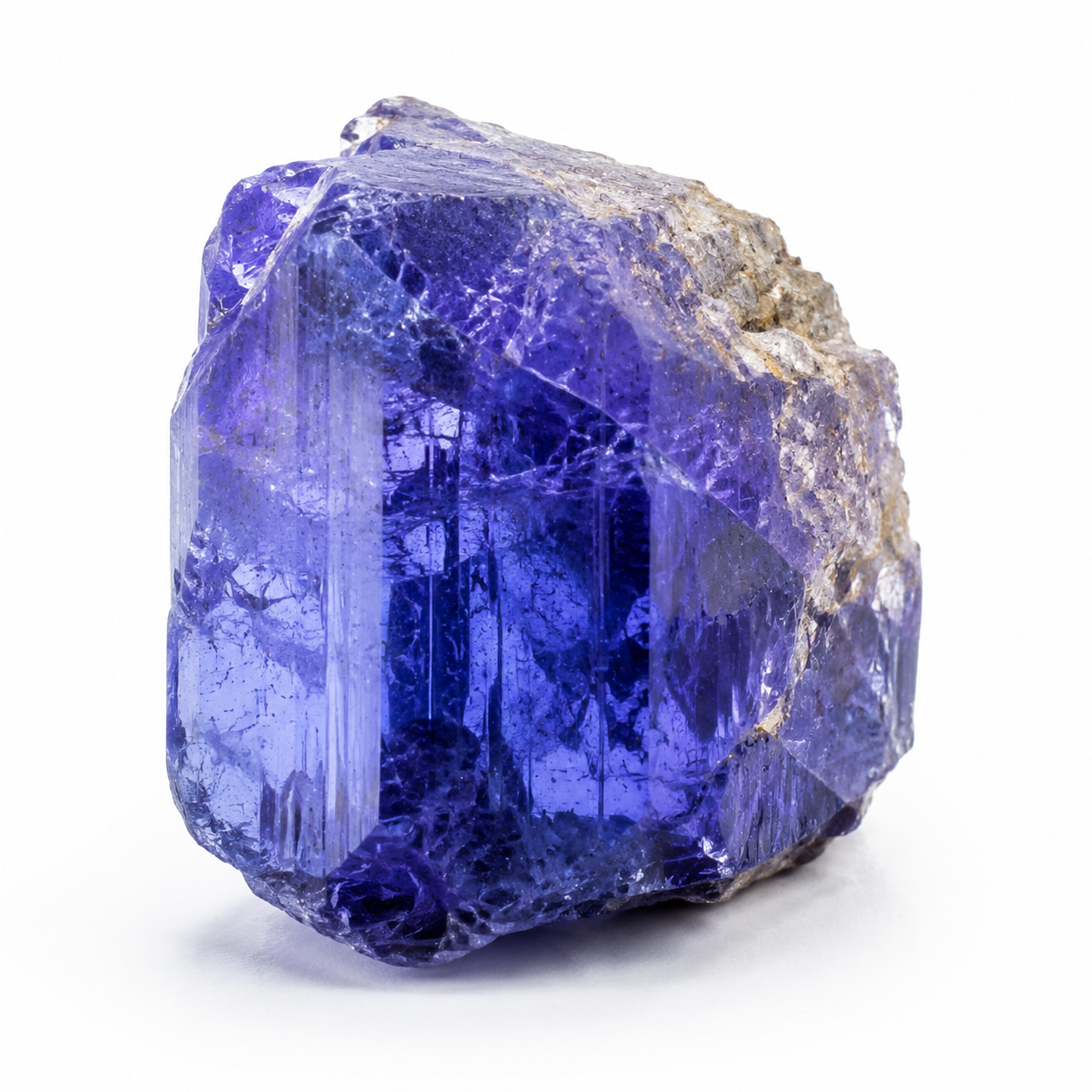
Mineral species: Zoisite (tanzanite variety)
Mineral group: Epidote group (zoisite)
Chemical formula: Calcium aluminum hydroxy sorosilicate [Ca2Al3(SiO4)(Si2O7)O(OH)]
Mohs hardness: 6.5
Crystal system: Orthorhombic
Lustre: vitreous
Transparency: transparent
Streak: White
Cleavage: Perfect in one direction
Fracture: Uneven to brittle
Specific gravity: 3.30-3.38
Refractive index: 1.69-1.70
Optical phenomena: Trichroism
Colour range: Blue, Green, Brown, Purple, Violet
Common inclusions: Needle-like inclusions, healed fractures, growth zoning
Geological environment: Tanzanite occurs in Metamorphic rocks in the Neoproterozoic Mozambique Belt. Its Orthorhombic structure reflects the pressure-temperature conditions of those host rocks, with notable occurrences in Tanzania (Merelani Hills, Simanjiro District).
Principal mining regions: Tanzania (Merelani Hills, Simanjiro District)
Important commercial sources: Gem-quality tanzanite is commercially sourced only from the Merelani Hills in Tanzania
Historical significance: Discovered in the 1960s and marketed globally as a single-source gemstone from Tanzania.
Common treatments: Heat treatment is routine to shift brownish rough toward blue-violet.
Synthetic or imitation forms: No widely commercial synthetic tanzanite; glass and synthetic corundum are used as imitations.
Common look-alikes: Iolite, sapphire, synthetic spinel
Jewellery uses: Tanzanite is used chiefly for Often best in pendants, earrings, collector cuts, and occasional-wear rings that showcase colour without unnecessary risk.. In the trade it is commonly fashioned as faceted stones, calibrated cuts, and higher-clarity collector pieces, with Mohs hardness 6.5 guiding suitable jewellery applications.
Care recommendations: Tanzanite should be cleaned with lukewarm water, mild soap, and a soft brush. At Mohs 6.5 in the Orthorhombic system, avoid steam cleaners, harsh chemicals, and high-impact wear. Protect cleavage directions from sharp knocks during wear and setting.